
Online Pokies in Australia, Looked at Properly
Reel Review pulls the flashing reels apart to show what's actually happening underneath: the maths, the software and the terms that most players never read before they spin.
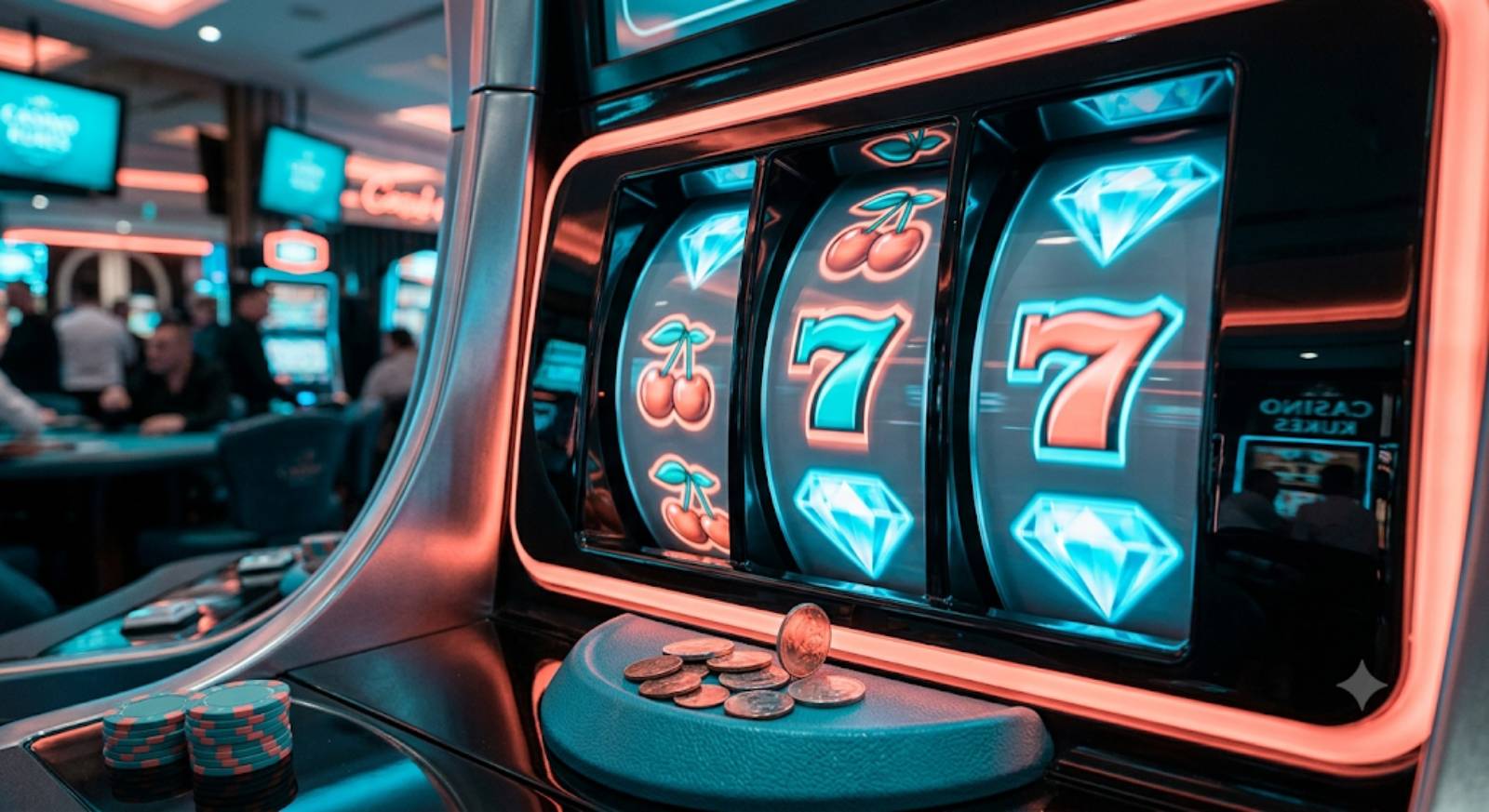
What are online pokies?
"Pokies" is the Australian shorthand for what much of the world calls slot machines: digital reels of symbols that spin and stop to form combinations across one or more paylines. Online pokies are simply the internet version, the same basic idea as a pub or club machine, rebuilt as software that runs in a browser or app rather than inside a cabinet on a gaming floor.
Under Australian law, games of this kind fall squarely into the category of online casino content, which the Interactive Gambling Act 2001 prohibits licensed local operators from providing to people in Australia. That is why the pokies you find advertised online are almost always hosted by operators based offshore, outside the reach of Australian regulators and consumer protection law. We unpack exactly what that means, in plain terms, on our legality page. Read that one first.
What makes an online pokie different from its physical cousin isn't the concept, it's the transparency problem. A physical machine sits in a regulated venue, inspected by a state gaming authority. An offshore online pokie is code running on a server you cannot see, governed by terms you probably haven't read, certified (or not) by a body you may never have heard of. That gap between appearance and accountability is the single most important thing to understand before anything else in this guide.
RTP explained: what "return to player" really means
Return to player, or RTP, is the theoretical percentage of all money wagered on a game that is returned to players as winnings over an enormous number of spins. That figure is typically modelled across millions of rounds, not the handful you might play in an evening. An RTP of 96%, for example, means that for every $100 wagered across that huge sample, $96 is returned as winnings and $4 is retained by the game as its margin, spread across every player who ever touches that title. In practice, most online pokies published today sit somewhere in the 94% to 97% band.
The trap is treating RTP as a short-term guarantee. It is nothing of the sort. Your own session (ten minutes, an hour, even a week of play) is a tiny, noisy slice of that theoretical curve, and short-term results routinely swing far above or below the published average in both directions. A 96% RTP pokie can hand you a heavy loss in one sitting and a windfall in the next; both outcomes are entirely consistent with the long-run figure.
| RTP band | What it suggests | What it does not tell you |
|---|---|---|
| Below 92% | Comparatively larger house margin over the long run | Nothing about your next spin, or the next hundred |
| 92%–96% | Typical range for many online pokies | Whether the figure has been independently verified for this specific site |
| 96%–98%+ | Comparatively smaller theoretical house margin | Actual payout behaviour, which also depends on volatility |
A further wrinkle: an offshore operator can advertise a game's RTP without any Australian body ever confirming that figure is accurate for the version deployed on that particular site. Because there is no local licensing regime for online casino content, the honesty of that number rests entirely on the operator and its software supplier. Treat a published RTP as a useful reference point, not a verified fact.
RNG and fairness: how outcomes are decided
Every legitimate online pokie is driven by a random number generator, a piece of software that produces an unpredictable sequence of values used to decide where the reels stop. A properly built RNG has no memory of previous spins and no awareness of how much a player has won or lost. Each spin is a fresh, independent event, mathematically unconnected to the one before it.
This matters because it directly rules out a whole family of beliefs players bring with them from land-based gaming floors: that a machine can be "hot" or "cold", that it is "due" for a win after a long losing run, or that playing at a particular time of day changes the odds. None of that is how a certified RNG behaves. If those ideas were true, the game would not be random; it would be exploitable, and no operator wants that.
The catch, again, is verification. Onshore-licensed gaming systems are typically tested by an independent laboratory against a recognised standard, with results available to a regulator. Offshore online casinos exist outside that structure. Some game studios do submit their RNGs for independent testing and publish certificates; others simply assert fairness. As a player, you are rarely in a position to check which is which, which is exactly why this guide encourages scepticism rather than assumption.
Volatility and variance: why some pokies feel riskier
Volatility — sometimes called variance — describes the pattern of wins over time, distinct from RTP, which describes the size of wins overall. Two pokies can share an identical 95% RTP and still feel completely different to play, because one pays frequently in small amounts while the other pays rarely but occasionally hits big.
- Low volatility: smaller, more frequent wins; your balance moves in gentle waves; fewer long dry spells.
- Medium volatility: a blend of the two, with occasional larger hits among more modest regular wins.
- High volatility: long stretches with little or no return, punctuated by the possibility of a much larger payout.
Neither profile is objectively "better". The honest way to think about volatility is as a risk setting that should match your own budget and tolerance for losing streaks, not a shortcut to better value. A high-volatility game with the same RTP as a low-volatility one is not more generous; it simply distributes the same theoretical return in a lumpier, less predictable way, which can make it far easier to overspend chasing a hit that may not come for a long time.
Free play versus real-money play
Most pokies available online can be tried in a free or "demo" mode using play credits that carry no monetary value. This is genuinely useful for understanding a game's pace, symbols, paylines and bonus triggers before any money changes hands, and we would encourage anyone curious about a specific title to start there rather than with a deposit.
What free play cannot show you is how the game feels once genuine loss is on the table. Behavioural research on gambling consistently finds that risk-free demo credits encourage faster, looser play than people adopt once their own money is at stake. The psychological weight of a real loss changes decision-making in ways a free trial simply does not replicate. Free mode also skips the parts of the real experience that matter most from a watchdog's perspective: deposit limits, withdrawal processing, KYC checks and wagering requirements, all of which only appear once you move to real-money play. We cover those payment mechanics in detail on our deposits and withdrawals page.
Free play teaches you the buttons, not the sting of losing. If you can't tell the two apart once real money is on the table, you've learned the wrong lesson from demo mode.
A further point worth flagging: because online casino games are not licensed for Australian players under the Interactive Gambling Act, moving from free demo credits to real-money wagering on an offshore site also means moving outside any local consumer protection. There is no Australian regulator to complain to if a real-money dispute arises, which is a materially different risk profile from the demo mode that preceded it.
Anatomy of a spin: what happens behind the screen
When you press "spin", a request goes from your device to the operator's game server, which is where the actual outcome is decided. Nothing meaningful happens locally on your phone or laptop beyond displaying the result. The sequence typically runs like this:
- The RNG on the server generates a fresh random value (or set of values) the instant the spin is triggered.
- That value is mapped against the game's internal paytable and reel configuration to determine which symbols land where.
- The result is sent back to your device, which plays the spinning animation you see. That animation is cosmetic; the result was decided before the reels appear to move.
- Any win is calculated according to the paytable and paylines in play, and your displayed balance updates accordingly.
- Wagering requirements or bonus conditions attached to your account, if any, are updated on the operator's side.
The animation is the part players focus on, but it is the least important step in the sequence. The outcome is fixed the instant the RNG produces its value, before a single reel appears to spin. Understanding that sequence is a useful antidote to the instinct to read meaning into how reels slow down or "almost" line up a jackpot symbol; those visual near-misses are presentation choices, not genuine indicators of anything mathematical.
Paylines, reels and bonus features
A payline is a pattern across the reels that, if the right symbols land on it, produces a win. Classic three-reel pokies might have a single payline running straight across the middle; modern video pokies commonly run anywhere from twenty to several hundred ways to win, and some titles dispense with fixed paylines entirely in favour of "cluster pays" or "all-ways" mechanics where matching symbols anywhere on adjacent reels can pay.
Bonus features layered on top of the base game are largely how modern pokies differentiate themselves: free-spin rounds, multipliers, expanding wilds, cascading reels, and "buy-a-bonus" options that let a player pay directly for entry into a feature round rather than triggering it naturally. Each of these mechanics changes both the volatility and, sometimes, the effective RTP of a session. A bought bonus feature, for instance, often carries a different mathematical return than the base game, and that detail is not always prominently disclosed.
Read a game's information panel (often a small "i" icon) before playing anything unfamiliar. It typically lists the RTP, the paylines or ways to win, and the mechanics of any bonus round: details that matter far more to your actual experience than the artwork on the reels.
Wagering requirements and bonus terms
Bonus credits and free spins offered by offshore operators almost always come attached to wagering requirements: a condition requiring you to bet through the bonus amount some multiple of times, often 20 to 50 times or more, before any resulting winnings can be withdrawn. These terms sit in a separate terms-and-conditions page that few players read in full, and they can be the difference between a bonus being genuinely useful and being effectively unusable.
| Term | What to check |
|---|---|
| Wagering multiple | How many times the bonus (or bonus plus deposit) must be wagered before withdrawal |
| Game weighting | Whether pokies count 100% toward wagering while other games count less, or not at all |
| Maximum bet while wagering | A cap on stake size that, if exceeded, can void your bonus and any winnings from it |
| Withdrawal cap | Some bonuses limit the maximum amount you can ever cash out from bonus-derived winnings |
| Expiry window | A time limit after which unused bonus funds and unmet requirements are forfeited |
None of these terms are illegal for an offshore operator to impose. As our legality page explains, there is no Australian licence governing them in the first place. The only real protection available to you is reading the fine print before you accept a bonus, not after. A bonus that needs $2,000 of turnover to release $50 is not a gift, whatever the banner says.
Common myths about online pokies
Plenty of folklore has migrated from pub gaming rooms to online play, and almost none of it holds up against how RNG software actually functions.
- "It's due for a win." A certified RNG has no concept of overdue outcomes. Past spins have zero influence on the next one.
- "Playing at a certain time changes the odds." Server-side RNGs do not run on a schedule tied to the clock; time of day is irrelevant to outcome probability.
- "Stopping the reels manually changes the result." The outcome is determined the instant the spin is triggered; any "stop" button is cosmetic.
- "A near-miss means a win is close." Near-misses are a well-documented design choice that makes losses feel closer to wins than they mathematically are.
- "Higher stakes unlock better odds." Bet size does not alter RTP or volatility settings; it only changes how much is at risk per spin.
Believing any of these can quietly push a player toward chasing losses or increasing stakes in search of a pattern that does not exist. Recognising the myth for what it is (folklore, not mechanics) is one of the simplest ways to keep decisions grounded in reality rather than superstition.
Reading a pokies site the way a watchdog would
Before trusting any claim an online pokies site makes about itself, apply a healthy dose of scrutiny rather than take the marketing at face value. A few habits worth adopting:
- Look for a specific, dated RTP figure per game rather than a vague blanket claim like "up to 98% payouts".
- Check whether the operator names an actual testing lab or auditor, rather than an unverifiable "certified fair" badge with no attribution.
- Read the bonus terms before you read the marketing copy promoting the bonus; the terms tell you what the offer actually costs you.
- Remember that no Australian regulator licenses or vouches for offshore online casino content, so due diligence sits entirely with you.
This is the same scrutinising approach we apply throughout Reel Review, and it is the reason we treat every operator claim as a starting point for questions rather than a fact to repeat.
Playing responsibly
Pokies are built to be engaging: fast rounds, frequent small wins and audiovisual feedback are all deliberate design choices that encourage continued play. None of that is inherently sinister, but it does mean the responsibility for pacing a session sits with the player, since the game itself is not designed to slow you down.
Practical habits that help: decide on a loss limit before you start and stop when you reach it, treat any win as a good moment to finish rather than a reason to continue, avoid playing when tired, stressed or affected by alcohol, and never treat pokies as a way to recover money already lost. If play stops feeling like entertainment and starts feeling compulsive, that is a signal worth taking seriously rather than pushing through. Our safe and responsible play guide goes into detail on limits, self-exclusion and where to find support, including Gambling Help Online, free and available 24/7 on 1800 858 858.
Frequently asked questions
Are online pokies actually random?
Reputable pokies run on a random number generator, meaning every spin is an independent event with no memory of what came before. There is no such thing as a machine that is "due" to pay or "cold" after a losing streak. That idea is a myth, not a mechanic.
What counts as a good RTP for an online pokie?
Most online pokies publish an RTP somewhere between roughly 92% and 98%. Higher within that range is generally better for the player over the long run, but RTP is a theoretical average calculated over millions of spins; it says nothing about what will happen in your next session.
Can you improve your odds when playing pokies?
You cannot change the underlying odds of a certified RNG game. No betting pattern, timing trick or "system" alters the maths. The only genuine control you have is over your own budget, session length and choice of games with clearly disclosed RTP and volatility.
Is free-play the same experience as real-money play?
Free-play versions are useful for learning a game's layout, paylines and features, but they remove financial risk and can encourage looser, faster play. Once real money is involved, wagering requirements, withdrawal rules and your own risk tolerance all come into the picture in ways demo credits never test.
Do all online pokies use the same RNG software?
No. Different game studios build and licence their own RNG engines, and the certification testing behind them varies by jurisdiction and provider. Because offshore casino sites operate outside Australian regulation, players are relying entirely on whatever standard the operator and its suppliers choose to disclose.
What does volatility mean for my bankroll?
Volatility describes how a pokie pays out over time, not how much. A low-volatility game tends to return smaller wins more often, while a high-volatility game pays rarely but can hit larger amounts, with longer losing stretches in between. Matching volatility to your budget matters more than chasing a single big number.